What does menthol actually do for a blocked nose?
Menthol makes a stuffy nose feel clearer within minutes, yet studies show it does not change how much air gets through. Here is what is really happening.
By the HEALTHORA team · 22 July 2025 · 5 min read
What is menthol?
Menthol is a naturally occurring compound from mint plants, most of it extracted from peppermint and cornmint oils, and it is what makes mint feel cold. It is in toothpaste, chewing gum, throat lozenges, chest rubs, cough drops, lip balm, and many nasal products, medicated and not.
Its usefulness in the nose comes from one specific property: menthol switches on the nerve endings that sense cold, without the temperature actually dropping. Everything else in this guide follows from that.
How does menthol work in the nose?
The lining of the nose is full of sensory nerve endings, carried by the trigeminal nerve, that report temperature and airflow to the brain. Part of how you know you are breathing through your nose is that those endings feel the slight cooling of air moving past them. When the lining swells and air slows, the cooling fades, and the nose feels blocked even before airflow is seriously reduced.
Menthol binds to the cold receptor on those same nerve endings, the one researchers call TRPM8. The nerve fires as if cool air were streaming through, and the brain reads that as an open, clear nose. The sensation arrives fast, within minutes, and it is real: the nerves are genuinely signalling. What has changed is the signal, not the airway.
Does menthol open the nose, or only feel like it?
This has been measured, and the answer is consistent. In a 1983 study at Cardiff, volunteers breathed camphor, eucalyptus or menthol vapour for five minutes while their nasal resistance to airflow was measured. None of the three changed resistance at all. Most volunteers nonetheless reported a cold feeling in the nose and a sense of improved airflow. Exercise, tested in the same study, did the opposite: it lowered resistance measurably and produced no cooling sensation.
A 1990 double-blind trial by the same group tested an 11 mg menthol lozenge against a plain candy in 62 people with congestion from a natural cold. Nasal resistance, measured by rhinomanometry, did not differ between the groups at any point over two hours. The menthol group’s own rating of how freely they could breathe improved significantly within ten minutes; the placebo group’s did not.
If it does not open the nose, why does it help?
Because the feeling is a large part of the complaint. A blocked nose is both a mechanical problem and a sensory one, and the two do not always track each other: people with measurably open noses can feel stuffy, and people breathing fine through a narrowed passage can feel clear. The cold-sensing nerves are a big part of what decides which you feel.
That makes menthol genuinely useful for comfort, and useless for anything that depends on airflow itself. If you are congested enough that oxygen or sleep are affected, menthol will not change that, and a pharmacist should be your next stop rather than another cooling product.
Menthol vs a decongestant: which does what?
- A decongestant such as oxymetazoline or pseudoephedrine constricts the swollen blood vessels in the lining, so the airway physically widens. It works on the mechanics, carries a three-day limit as a spray because of rebound congestion, and has body-wide cautions as a tablet.
- Menthol acts on the sensory nerves, so the airway feels clearer without changing size. There is no rebound, because no blood vessel was constricted, and no three-day limit for that reason.
- The two are often combined in one product: a decongestant for the airway plus menthol for the feeling. The label tells you which you are holding; "cooling" alone does not mean decongestant.
Is menthol safe?
Menthol has been in everyday products for well over a century and is generally well tolerated in the amounts found in them. It can sting or burn briefly on contact with the lining of the nose, and it should be kept out of the eyes. Follow the directions on whichever product you are using, and ask a pharmacist about use in young children, where the directions on menthol products are typically more restrictive.
Where does Healthora Nasal Comfort Spray fit?
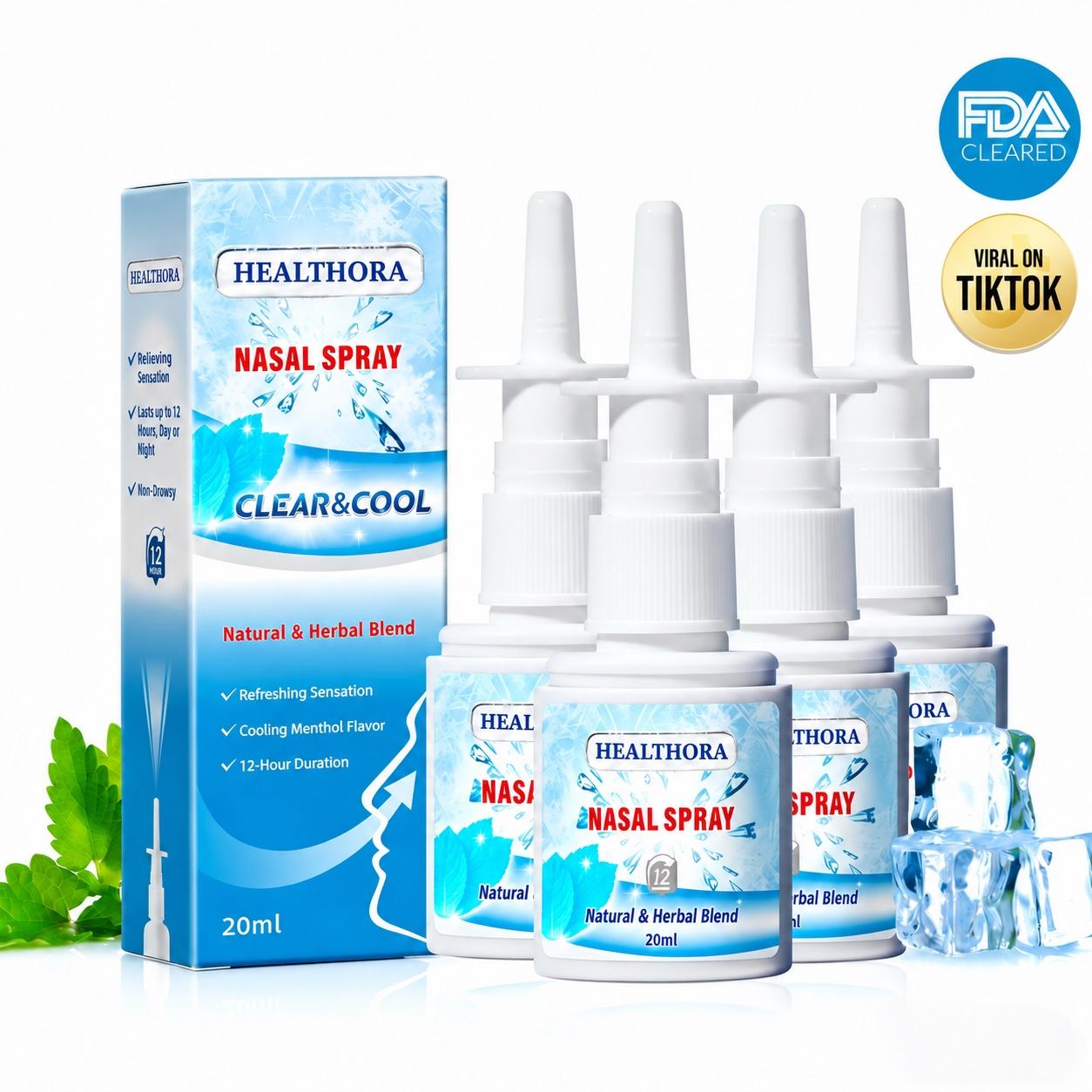
Healthora Nasal Comfort Spray is a natural and herbal blend with a cooling menthol flavor, made for daily sinus comfort. It is not a decongestant medicine: it contains no oxymetazoline, pseudoephedrine or phenylephrine, so there is no rebound effect to manage and no three-day rule. What the menthol does is exactly what this guide describes, and the carton prints the full ingredient list, the uses and the warnings, which the product page repeats.
If what you want is the cool, clear feeling through a working day or at bedtime, that is what it is for. If airflow itself is the problem, read the guides on oxymetazoline and pseudoephedrine, and talk to a pharmacist.
This guide is general information, not medical advice. Read the label of any medicine you take, and ask a pharmacist or doctor about your own situation.
Sources
- Burrow A, Eccles R, Jones AS. The effects of camphor, eucalyptus and menthol vapour on nasal resistance to airflow and nasal sensation. Acta Otolaryngologica, 1983
- Eccles R, Jawad MS, Morris S. The effects of oral administration of (-)-menthol on nasal resistance to airflow and nasal sensation of airflow in subjects with the common cold. Journal of Pharmacy and Pharmacology, 1990