What is oxymetazoline, and why can you only use it for three days?
Oxymetazoline is the ingredient in most 12-hour decongestant nasal sprays. How it works, how to use it, and why the label stops you at three days.
By the HEALTHORA team · 3 December 2024 · 6 min read
What is oxymetazoline?
Oxymetazoline (ox-ee-meh-TAZ-oh-leen) is a nasal decongestant applied directly inside the nose as a spray, mist or drops. It is sold without a prescription and is the active ingredient in most of the "12-hour" decongestant sprays on the shelf: Afrin, Vicks Sinex, Sudafed OM, Zicam Extreme Congestion Relief, Mucinex Sinus-Max spray and the store brands next to them, typically as a 0.05% solution.
It is approved for the temporary relief of nasal congestion from the common cold, hay fever and other upper-respiratory allergies, and of sinus congestion and pressure. Like other decongestants it relieves the blocked feeling; it does not treat the cold or the allergy behind it.
How does oxymetazoline work?
Congestion is swelling: the blood vessels in the lining of the nose widen and the tissue puffs up until there is little room for air. Oxymetazoline is a sympathomimetic that acts on the alpha-adrenergic receptors in those vessels and makes them constrict. The tissue shrinks and the airway opens.
Because it is sprayed where the swelling is rather than swallowed, it acts fast, usually within a few minutes, and very little of the dose reaches the rest of the body. That is the advantage over an oral decongestant like pseudoephedrine. The disadvantage is what happens to the nasal lining when it is used for too long, which is the next section.
Why does the label say no more than three days?
Oxymetazoline constricts blood vessels hard. When a dose wears off, the vessels do not simply return to normal; they tend to overshoot and widen more than before, so the nose feels more blocked than it did to begin with. The natural response is another spray, which works, and wears off into a worse rebound. After a few days of this the lining depends on the spray to stay open at all.
Doctors call it rebound congestion or rhinitis medicamentosa. It is not an addiction in the pharmacological sense, but people describe it that way because it feels like one: the spray becomes the only thing that works, and stopping it means several uncomfortable days while the lining recovers. The three-day limit on the label exists to keep you clear of that cycle.
How do you use oxymetazoline nasal spray?
Read the label of the product in your hand; what follows is the standard set of directions for a 0.05% spray.
- Blow your nose gently first.
- Keep your head upright. Do not tilt it back.
- Insert the tip into one nostril, close the other, and squeeze firmly while breathing in gently. Repeat for the number of sprays on the label, then the other nostril.
- Wipe the tip and replace the cap. Do not share the bottle: the tip touches the inside of the nose.
- Adults and children 6 and over: usually 2 or 3 sprays in each nostril, no more often than every 10 to 12 hours.
- No more than 2 doses in any 24 hours.
- No more than 3 days in a row. If you are still congested after that, stop and see a doctor.
- Children under 6: only on a doctor’s advice. Children 6 to 12 should use it under adult supervision.
Who should not use oxymetazoline?
Less of it reaches the bloodstream than with a tablet, but enough can to matter for some people. Ask a doctor or pharmacist before using it if you have:
- high blood pressure or heart disease;
- diabetes;
- thyroid disease;
- trouble urinating because of an enlarged prostate;
- an allergy to oxymetazoline or to other decongestants.
Do not use it if you take a monoamine oxidase inhibitor (MAOI) or have in the last two weeks. If you are pregnant, planning to be, or breastfeeding, ask a doctor first.
What are the side effects of oxymetazoline?
Most are local and brief: a burning or stinging feeling, sneezing, dryness, or more discharge for a moment after spraying. Some people notice nervousness, a headache, nausea, dizziness or trouble sleeping, which are signs that some of the dose has reached the rest of the body.
The side effect that matters most is the rebound congestion described above, and it is entirely a matter of duration: three days or fewer, and it is unlikely; daily use for weeks, and it is probable. Stop and seek medical help for a fast or pounding heartbeat, severe dizziness, or any sign of an allergic reaction.
Oxymetazoline spray vs an oral decongestant
The two reach the same swollen vessels by different routes. A spray gets there directly: fast onset, up to 12 hours of effect, little in the bloodstream, but a hard three-day limit. A pseudoephedrine tablet gets there through the blood: slower to start, a shorter effect per dose unless extended-release, more body-wide side effects, but it can be taken for up to seven days and does not cause rebound in the nose.
For a cold that will be over in a few days, a spray fits the timeline. For allergy season, neither is meant to be used for weeks on end, and a doctor or pharmacist can point you to treatments that are, such as steroid or antihistamine sprays, which work differently and have no three-day limit.
Where does a non-medicated spray fit?
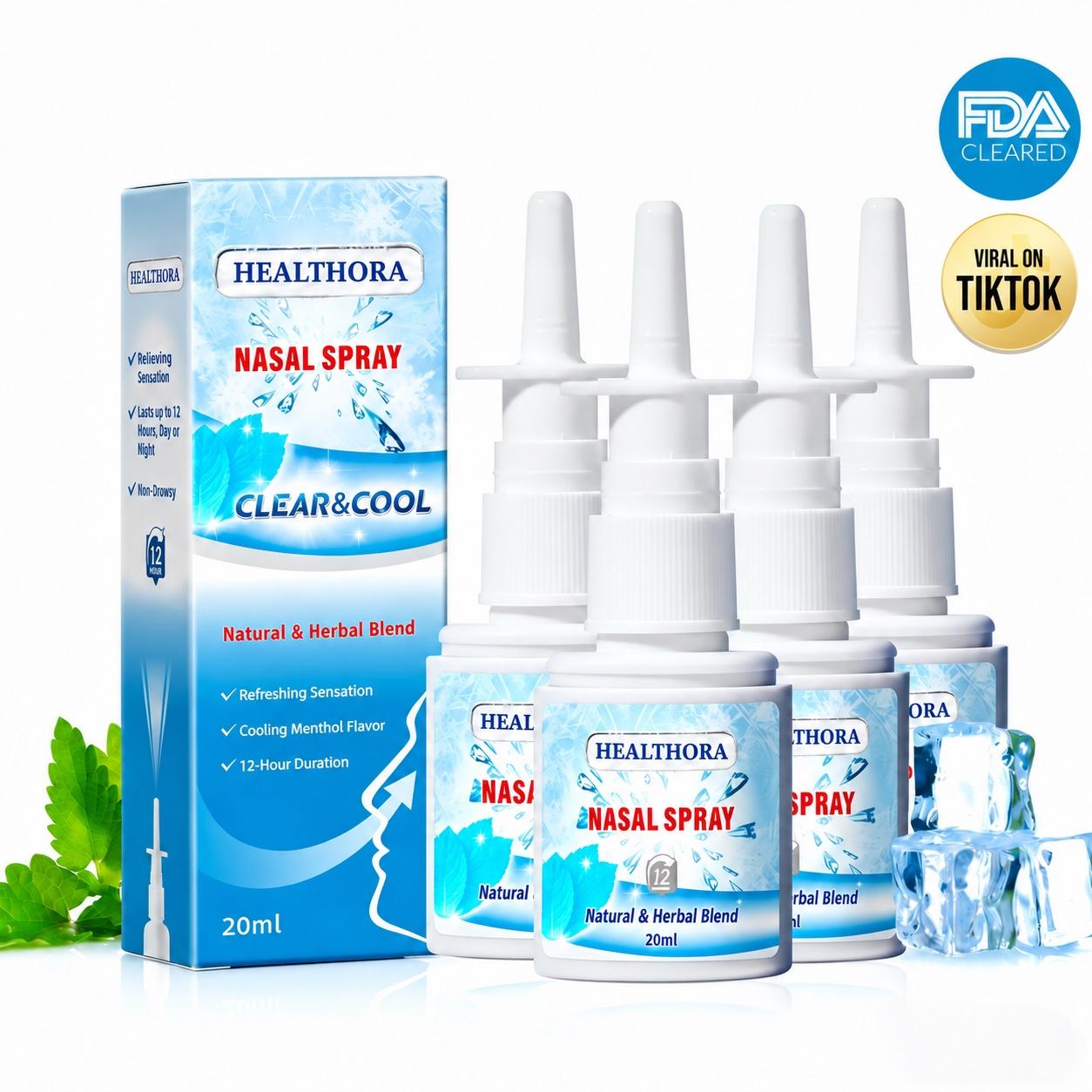
The three-day rule leaves a gap: everyday stuffiness that is not a cold and not worth a medicated decongestant. Healthora Nasal Comfort Spray is not a decongestant medicine and contains no oxymetazoline, pseudoephedrine or phenylephrine. It is a natural and herbal blend with a cooling menthol flavor, made for daily sinus comfort, with its ingredients, uses and warnings printed in full on the carton and repeated on its product page.
If you have found yourself leaning on a medicated spray past its three days, the first step is a conversation with a pharmacist, not a different bottle. After that, read the carton and decide whether a non-medicated spray has a place in your bag.
This guide is general information, not medical advice. Read the label of any medicine you take, and ask a pharmacist or doctor about your own situation.